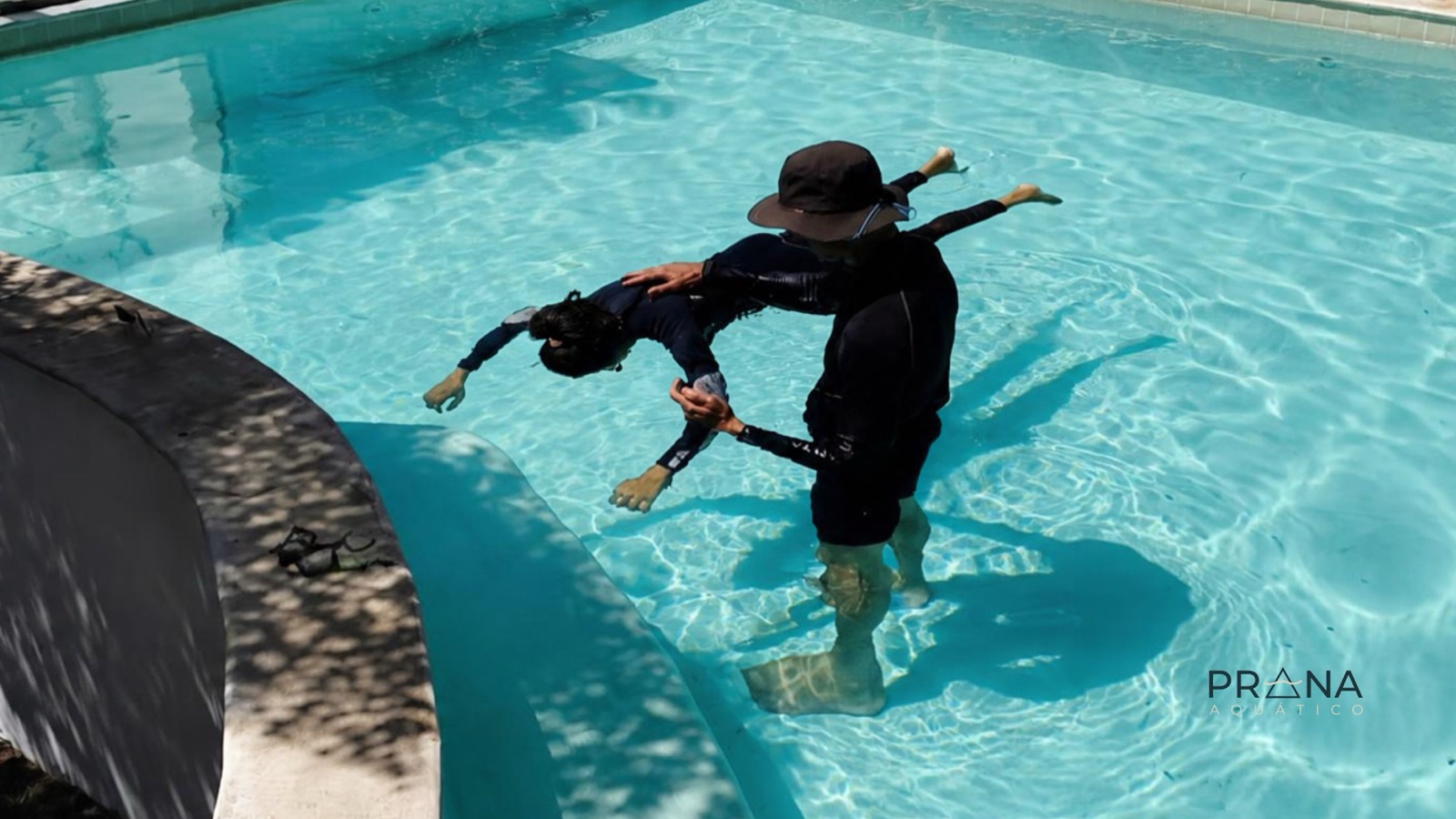
On the outside, almost nothing
In freediving, static apnea is one of the pool disciplines: you float face down, without moving, and hold your breath. There is also dynamic apnea, where you swim horizontally, and there are the depth disciplines, done at sea.
Of the three, static is the quietest. No movement, no descent, nowhere to go. In competition, the stopwatch rules. Outside it, time stops being the question, and a far more interesting one takes its place: what happens to you when nothing happens?
On the inside, a conversation
When your face touches the water, the heart tends to slow down. This is the diving reflex, a response we share with other mammals, and in apnea it becomes easy to notice.
Then the urge to breathe arrives. At first it doesn't come from a lack of oxygen, but from carbon dioxide building up: that is how the body asks for air. It knocks politely; it doesn't break the door down. Much of what the practice teaches is how to hear that knock without panicking.
You don't win the pause
Intuition says apnea is a matter of willpower. The opposite turns out to be true. The practice works through relaxation: tension burns oxygen, and the harder you fight the pause, the shorter it gets.
So at Prana Aquático, nobody chases a stopwatch or a time target. You end the pause whenever you like, and ending it counts as practice too. Respecting a limit is a way of paying attention.
The rule with no exceptions
In apnea, loss of consciousness can come without warning, and the person holding their breath doesn't always notice they have reached their limit. That is why the freediving rule is the same all over the world: never practise apnea in the water alone. Not in your pool at home, not in a waterfall, not at sea. In the immersion, every apnea happens under qualified supervision, with someone beside you who knows what to watch for.
For the same reason, breathing fast and deep several times before a hold, known as hyperventilation, is discouraged. It makes you feel you can last longer, but it delays the body's warning signal, which is exactly what keeps you safe.
What comes back up with you
During the pause, the urge to breathe arrives, grows and asks for a reaction. You notice the impulse before acting on it. It is a small, very concrete rehearsal of something that happens all day long out of the water: the email that annoys you, the queue that won't move, the difficult conversation. Feeling the discomfort arrive, and choosing the response instead of reacting on autopilot.
That is where the central idea of Prana Aquático comes from: inhabit the space between impulse and reaction.